![]() |
| Pre-race hydration |
![]() |
| Emaad and I at the start |
![]() |
| Early on |
![]() |
| Sunset beyond Tuggle |
![]() |
| Old RR mileposts on the trail |
![]() |
| Emaad on High Bridge |
![]() |
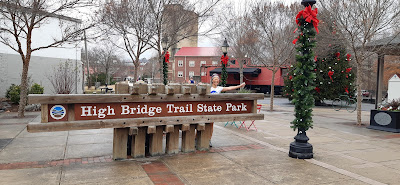
| Sign in Farmville marking the trail |
![]() |
| Swag: shirt, coaster, sticker and bib |
![]() |
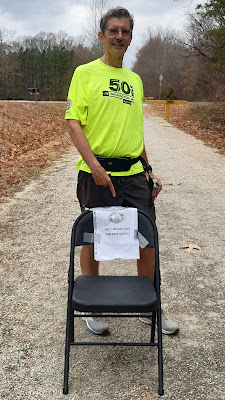
| Pre-race hydration |
![]() |
| Emaad and I at the start |
![]() |
| Early on |
![]() |
| Sunset beyond Tuggle |
![]() |
| Old RR mileposts on the trail |
![]() |
| Emaad on High Bridge |
![]() |
| Sign in Farmville marking the trail |
![]() |
| Swag: shirt, coaster, sticker and bib |
Preparation
Having run Farm Park Challenge last year (report here), I know that one parks right at the start-finish so one's car becomes one's drop bag. And since the forecast calls for rain and temperatures in the 50s at the Agricultural History Farm Park, the car provides a dry - and large - drop bag. Since I'll be running five laps of the course, I'll pass my car four times (and at the finish) so I stock it with six shirts, an extra poncho, four pairs of gloves, four hats, extra buffs, towels and bandanas. And dry clothes for the finish.
![]() |
| Early on not too muddy |
Back and Forth
The course is an out-and-back mostly on the the Upper Rock Creek Trail. It is mostly new territory for me and is a mix of grassy surface, some double wide track, a bit of paved trail in the middle, and a small stretch of single track. Three small bridges cross Rock Creek and two smaller streams. The rain is light but steady, and the course gets muddier and more slippery as the day goes on.
At the end of the first lap (1:03:29) I go to the car, change both shirts under the damp poncho, and change my gloves and hat.
The second loop is much like the first, only the course is getting more slippery. I chat a bit with Monika B., who is only running two loops as she has other commitments for the day.
![]() |
| In the third loop with the second poncho and third hat. |
![]() |
| The bridge over Rock Creek |
![]() |
| It's a stream trail |
![]() |
| At the finish with muddy legs and beer |
| Caroline at the trail sign in Farmville |
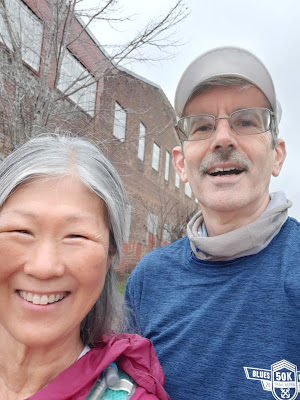
| Caroline and I at the start |
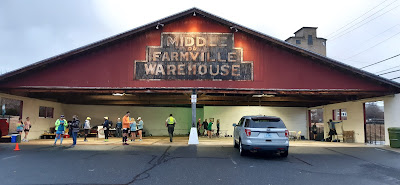
| The start-finish at the Farmville Farmers' Market |
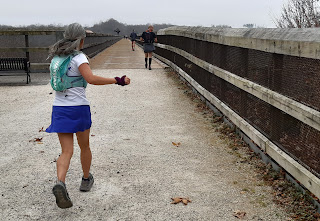
| Caroline heads across High Bridge |
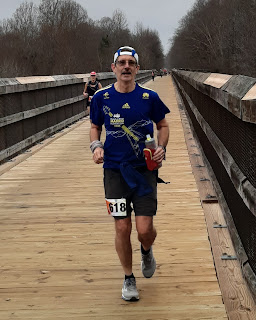
| Crossing High Bridge |
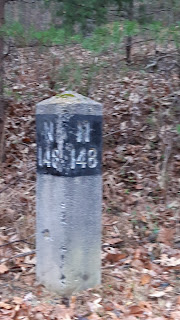
| Railroad Mile Marker |
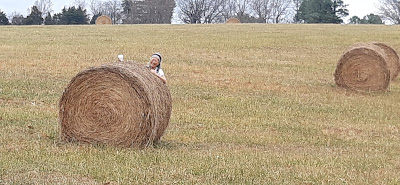
| Caroline plays among the hay rolls |
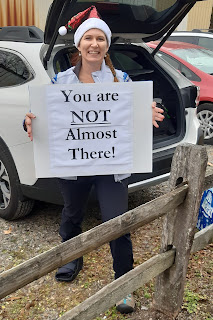
| True dat - especially at mile 8 |
| The turnaround |
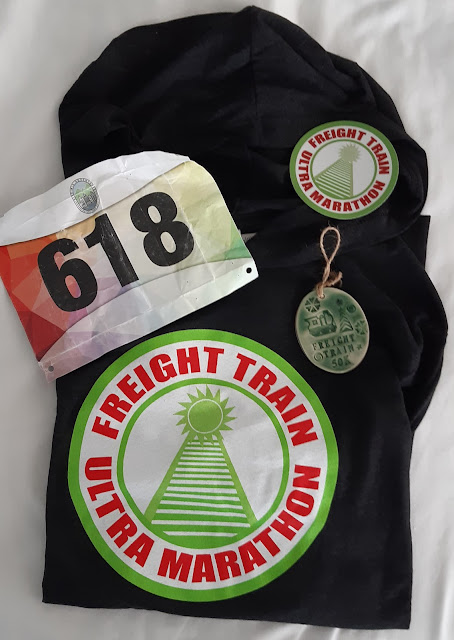
| Swag: hooded shirt, ornament, sticker and bib |
Nightmares
The night before the Pass Mountain 50K, I cannot sleep. I'm worried about the weather for the race, specifically, the forecast for higher than normal temperatures. I have a history of not coping well with hot conditions. In June, I dropped out of Ran It with Janet 50K partly due to the 90 degree heat. In February, 2020, I dropped from Elephant Mountain 50K, at least in part due to the heat.
![]() |
| Cathy and Emaad choose another way at Boyce Thompson Arboretum |
Earlier on Friday Emaad and I meet our friend Cathy at the Boyce Thompson Arboretum in Superior. She is a member and an enthusiastic gardener, and she treats us to an hour long guided tour of the main trail at the arboretum. The shaded portions are pleasant, but I feel the heat when we are in unshaded parts of the walk.
Even though I have a plan to deal with the heat, I spend a troubled night, never quite being able to sleep for any length of time. No need for the alarm; I'm awake and up well before I have to be.
First Loop
The course consists of two loops around Pass Mountain. From the race website, it looks relatively flat, with most of the 2500 feet of ascent in the two climbs from the second aid station (mile 6.8 of each loop) and the passage at Bulldog Saddle at the top of the trail. And that climb is followed by a nice four mile descent back to the start finish area. Since we did over 3000 feet of climb at Boulder Field 50K, this doesn't sound at all bad. And it is in the desert, so no roots to contend with or trip over. Maybe just a few rocks.
The race starts at 7 o'clock sharp. The 58 entrants in the 50K head out onto the smooth dirt of the trail. Emaad and I are toward the rear and as usual we chat with the runners around us. We don't push the pace, but don't go too slowly either, figuring that the more miles we can log while the sun is still low (sunrise was 6:56 a.m.) and the temperatures down, the better off we will be later in the day.
![]() |
| Emaad runs into the sun on the levee (mile 3) |
The course rolls just a bit for the first couple of miles, then turns onto a levee built to protect a neighborhood on the edge of the park for flash floods. We get through the eponymously named Levee aid station (mile 3.8) in 44 minutes, get back on the levee and continue for a bit more before the trail leaves it for more generally flat track to the next aid station at mile 6.8.
From here it is 8.6 miles back to the start-finish. I make sure that my hydration pack is filled to its 1.5 liter capacity. Fellow runner David, who is using trekking poles and has run the race previously, gives us a brief on what to expect ahead.
The course heads up gently, between the Cat Hills, then along a bit of gently rolling, but rocky, trail running to the east. We chat with a couple of women runners about the difference of running in the East and the West. A hiker wearing a sidearm passes us going the opposite direction. (Protection against snakes? Loaded with snake shot? Protection from other wildlife?) We are in a different culture here.
![]() |
| Looking toward Pass Mountain from the south (mile 4) |
The trail turns northward and upward, but the rocks do not end. The trail is rockier that I had anticipated and it makes running difficult. Up we go. Since this is the desert one can see the runners - actually mostly walkers - on the trial ahead and above.
Finally we come to a switchback that is just solid rock and steeply upward. This is the point that David told us would mark the final ascent to Bulldog Saddle. Just before we reach the top we come upon a pair of mountain bikers preparing to descend that stretch. It seems to be an ill-advised and particularly risky idea but we go on leaving them to their effort. We see them later in the day unscathed.
Cresting the saddle, we now have four miles and 700 feet of descent to the end of the first loop. It should be a place to make up time. Emaad takes off. But I proceed slowly. As I've gotten older, downhills have become troubling - I am becoming increasingly afraid of falling and am losing confidence in my ability to bound down them. The trail is still rocky, and there is nothing be a steep slope on one side. A misstep, slip or stumble in the wrong direction and it will be a slide down a rocky, cactus slope for who knows how far. Adding to the concern, portions of the trail are eroded, further narrowing the path.
![]() |
| Headed toward Bulldog Saddle |
I go on, unconfident of the trail, but confident that I'll make the four and a half hour cutoff at the end of the first loop.
Second Loop
Emaad is waiting for my at our drop bags. The day is now hot, and the portapotty that I use is sweltering. I change shirts, fill the hydration pack and grab my handheld water bottle. My plan is to use the water in the hydration pack for drinking and the water in the handheld for cooling, pouring it on the cooling towel I have around my neck.
We cross the mat to start the second loop in 4:11. This gives us officially 4:49 to run the second loop to finish under the official nine hour cutoff. But we not particularly concerned about that, knowing that the 50 milers on a somewhat differ course will still be out there later than us.
We have barely gone a few hundred yards than we come across a runner sitting by the side of the trail. He says he is OK but has decided to call it a day. A bit further along we come across another runner walking back toward the start-finish. He, too, tells us that he is calling it a day.
By now we are pretty much alone. I want to run, but Emaad urges that we go easy, as the time is approaching noon, the sun is high, there is no shade, the day has become hot and we still have a long way to go. It's good advice. We mostly walk, or walk and run.
We spy a runner ahead, mostly walking and talking on her phone. When she is done with her call we fall in with her and the three of us proceed together sharing stories. It turns out that she had run the 2019 DC North Face Endurance Challenge 50K, the same race at which Emaad and I had run a bit with ultralegend Dean Karnazes.
She is a recent graduate of George Washington University, and is interested in international humanitarian efforts. I tell her that I know someone who works at the Agency for International Development and that if she wants I can put her in touch with him. In an only-in-DC moment I tell her that I happen to have one of my business cards in the rear outside pocket of my hydration pack (how many other trail runners carry their business cards with them?) and that she is free to take a picture of it so that she can contact me later. I had the business card with me because I had written the race emergency number on it in case I needed it on the trail. But still . . . a business card?
She is talking about dropping at the Levee aid station, but we and the aid station workers talk her into going on. At one point Emaad and I get a bit ahead of her and exchange concern about her. We wait and she catches up with us and assures us that she is fine, but is going to drop out at the Meridian aid station (mile 22.2). She has to get to CVS in time to get a COVID test as she is flying to Germany on Monday.
As we approach the aid station, a volunteer meets us. He, too, tries to talk her out of dropping, but her mind is made up. She calls one of her friends (one dropped, one finished) to come pick her up.
Emaad has gone on ahead, and calls back to me to pick up his handheld, as he left it behind. I do, and after a couple of hundred yards I curse myself, because in getting his I left my behind. I turn back to get it. A volunteer sees me coming back and realizes what I had done, and brings it out to meet me, saving me precious steps.
Now we are alone and the day is hot. We have been over this ground before, but somehow it seems longer, probably because we are going slower. (On the first loop we did the 6.8 mile distance from the start to the Meridian aid station in 1:27. It took 2:00 on the second loop.)
I'm keeping my cooling towel wet with water from the handheld. But the upward climb seems endless. With no runners (or even hikers for that matter) on the trail ahead, it is hard to know where the saddle is. All I see is mountainside, with no obvious way over.
But eventually we reach the "just rocks" part, and partially on all fours, I crest Bulldog Saddle.
![]() |
| Looking to the north from the Pass Mountain trail (mile 29) |
As on the first loop, Emaad takes off downhill and I trudge downward. At least now this side of the mountain is partially in the shade. A good thing too, as I'm starting to ration both my drinking water in the hydration pack and the cooling water in the handheld.
About a mile down the trail I come upon Curtis, a runner who, it turns out, had been thru the Meridian aid station 18 minutes ahead of us. He is not looking well. I offer him a salt tablet, and I take my last one. Then I go on, but keep looking back to see how he is doing. He is moving forward, so I figure he will be OK.
I've run out of water in my handheld, so I use water from my pack to wet my cooling cloth. But than causes me to even further cut back on what I drink. I try a trick from Emaad - take a sip and swish it in your mouth for awhile before swallowing. Anything to make the water last.
With about a mile left, first one leg, and then the other starts to cramp. I use a nearby bench to press back and stretch. Somewhat successfully, I resume moving. But then I start to get lightheaded and stop on a rock to put my head down. The cramping resumes. I start to wonder if it is time to get out the business card to dial the emergency number. But both the dizziness and cramping subside. On I go. But I'm out of water.
I ask a runner headed in the opposite direction if he has a gel, forgetting the I have two on me. He doesn't. A bit later I cross paths with a mountain biker. He asks if I'm OK, and when I hesitate, he asks if I want some water. He pours some, including some ice, from his hydration pack into my bottle. The cold water is refreshing, both inside and out.
![]() |
| Live Results Screenshot |
Curtis comes in 20 minutes behind me.
Finisher or Not?
The live tracking shows that I finished in 9:29:47, 37th overall, and 24th male. I was the oldest finisher by five years. Emaad finished in 9:09:33. Curtis was the only finisher behind me.
The temperature tops out at 88 degrees, ten degrees above the normal high for November 13 in Mesa. It takes a toll on the runners. Only 38 of the original 58 starters will be recorded as finishers, an attrition rate of 35 percent. This is far above the attrition rate for the previous three Pass Mountain 50Ks, where the rates were 15, 13, and 14 percent, respectively.
When the results are posted to Ultrasignup, we three are all listed as DNFs. We went from finishers to non-finishers.
![]() |
| At the Finish |
We get no response for eight days, so I write again. The race director responds to Emaad and I agreeing to do so, although not without a bit of a backhand: "because you seem so passionate about receiving a finish for a race that you finished over the official cutoff, we will allow your result to be posted." But he doesn't do so for Curtis who remains a DNF. On the other hand, while not telling us, he moves a 50-mile finisher from a reported "did not finish under the cutoff" to an official finisher.
We didn't make the cutoff. If, at finish I was told that I was a DNF I would have accepted that. But the company ignored the cutoff for another one of its races, so consistency is expected. Once you tell me I'm a finisher and give me a finisher's medal, you do not get to unfinish me. (And at my age, I need all the finishes I can get.)
![]() |
| Swag: Shirt, Bib and FINISHER'S MEDAL |
![]() |
| Even modest victories have a price |
Agility I
Preparing my gear late Friday night before the race I realize that I had not brought a handheld bottle. And since the aid stations are conveniently close to one another, I hadn't brought my Nathan pack. Two alternatives are possible. First, run without hydration and rely on the aid stations. It's possible but the day promises some unseasonably temperatures in the upper 70s and gulping liquids every few miles and then running without does not seem like a good plan. Second, Emaad's cousin, whose home we are staying at, offers a couple of small 6-ounce bottles of water. Better than the first alternative I decide, and I take them.
Getting in the car Saturday morning for the drive to the race, I spot a wide-mouth empty16-ounce bottle from an iced tea I bought on the drive from Maryland. It's ridged, which will improve the grip and it has a wide mouth, which will make refilling easy. I pour the water from the smaller bottles into it and I'm ready to race.
Agilty II
![]() |
| It's not an Uberendurance event without Uber Hans and his accordion. |
With barely six weeks to race day, Stephan Weiss, the Uberendurance Sports race director, arranged to move the race to Pennypack Park, where he puts on several other races. Not only does he move the race, but he has to figure out a course.
With great agility he does so, although the last minute maneuvering means he cannot provide a trial map in advance, only assuring runners that it would be two loops, and that half of the course would use trails used in the Dirty German (my 2019 report here) and half would be new trails. And he promises five aid stations per loop, and a total of eleven for the marathoners.
Fly and Die
We know the Pennypack drill: park on the street, make a very short walk to the pavilion, get our bibs and shirt, stash our drop bag, listen to Uber Hans play his accordion, eye the other runners. Aa couple of minutes before 8 a.m. Hans plays the National Anthem on his squeeze box, Stephan calls the runners to the start line and we are off.
![]() |
| Emaad follows other runners early in the race |
Soon enough the field starts to stretch out, and parts of the course are wide enough to permit faster runners to move ahead. Emaad and I settle into a nice rhythm, not too fast, but definitely quicker than usual.
After a few miles I'm still feeling good. Lacking impulse control, I tell him that I'm going to go on. I know exactly what I'm doing and it is something I haven't done in several years. It's fly and die time - run as fast as you can for as long as you can and hope that the finish is close enough when you run out of fuel and crash. It is a terrible strategy, but it can be fun while it lasts. Then it gets ugly. And you never know when the fly part will end, adding to the excitement. It's Russian roulette in trail shoes.
Running with several other runners, we pass a pair of mountain bikers on the side of a single track trail built with bikers in mind, with log jumps and plenty of twists and turns. One has thrown his chain and is fixing it. Soon they are back on the path and politely pass us as we all head downhill.
Goals
![]() |
| Still flying in the second loop. |
About three quarters of the way through the first loop I decide to set some goals for the day. I rarely set them before the race: "just want to finish" is my usual response. But once I get going goals help to motivate me.
So I set five: finish the first loop before anyone in the half marathon (starting an hour later) passes me; finish the first loop before the leader of the marathon finishes; finish the first loop under 3 hours; finish the marathon under 6 hours; finish the marathon under 6:30.
The first goal gets blown away with miles remaining in the first loop. And then again. And again. Ultimately nine half marathoners will finish their race before I get to the end of the loop, even with an hour headstart.
But I don't notice anyone with a marathon bib pass me as I approach the start finish line. One goal accomplished.
I cross the line at the end of the first loop in 2:45! I change my shirt and head out on the second loop. Still flying! And I start thinking that 6 hours is definitely in play. I can slow down by half an hour on the second loop and still make it.
Awhile into the loop my GPS reads barely 13 miles. That's odd, since the first loop, a half marathon should have been 13.1 miles. Maybe that explains the speedy - for me - first loop. But no matter. Stephan had to put a course together quickly and did. In trail runs, the distance is what the race director says it its. And woe to those who insist that the distance isn't what the race director says. The founder and race director of the Seneca Creek Greenway Trail Marathon and 50K added a "spite mile" the next year after fielding complaints that the course was longer than the advertised distance. (For the record my GPS logs 24,8 miles. It is what it is. You still have to go from the start to the finish.)
![]() |
| Trail next to Pennypack Creek (mile 18.5) |
Catching up with a pair of runners I channel the Blues Brothers: "It's eight miles to the finish, I have half a bottle of water, two gels, and I'm wearing sunglasses. Let's hit it." One runner, missing the reference, helpfully offers a gel and says the next aid station is near. The other runner gets it. (Yes, the movie is 41 years old and I'm showing my age with the reference, but it's a classic. Right?)
Bees? What bees?
A runner asks me if I'd been stung. No, I reply, a bit puzzled by the question, She tells me she had been stung seven times. Apparently there is a yellow jacket nest on the trail and the residents have taken offense at the disruption caused be the runners. They have taken to attacking them, and since they are yellow jackets and not bees, can sting multiple times. (Emaad will report being stung five times, from his ankle to his thumb.)
A course marshal also warns of the hazard on the second loop and says to stay to the left of a white-topped can he has placed near the nest. When I get to the spot, I heed his advice and remain unstung.
Crash and Burn
![]() |
| Crossing Bridge over Pennypack Creek (mile 7) |
I'm well into the second loop, about mile 16, and moving along well. The plane is flying smooth and level. All is going smoothly.
Until it isn't. I catch a foot and head toward the ground. There is a rock sticking up toward me as I go down, and I stretch out to avoid catching it with my ribs. I succeed, but the cost is a scraped up right knee and right forearm. Blood runs down the knee. I examine what has happened and don't feel any significant problems with the knee or the arm. The damage is superficial and I am able to go on.
But the fall has taken the "fly" out of me. There is an aid station a little bit ahead and I use wipes meant for cleaning surfaces to clean the scrapes. I decline the offer of water to wipe off the dried blood that has reached to my sock, figuring to wear it as a badge of honor.
Recharged
On I go, no longer flying high. Physically I don't feel bad, but the fight is out of me. Through the mountain biker trail loop, along the relatively flat stretch along the north side of Pennypack Creek and back to the aid station. Continue on the gently rolling single track of the southernmost loop, under the overpass at Bustleton Avenue and on to the aid station under Krewstown Road at about mile 20.5. Then over the bridge to the other side of the creek. This section of the trail is about 2.5 miles along the creek and the trail is frequently double wide with few rocks and roots.
I start running with Amy, a runner doing her first trail marathon. Having someone to run with starts to recharge my mental battery. A peek at the GPS get me thinking that maybe 6 hours is still in play. And having a new running friend means I get to tell my old stories to fresh ears.
As we come to the final aid station (mile 23.5) I yell out, "Whiskey for my men, beer for my horses." Sure enough, a bottle appears and a shot appears. I beg off, as I'm back to aiming at the 6 hour goal. But I do accept half a brew. Gotta hydrate for the final push.
Amy and I go on. I'm glancing at my watch more and more, but the time is slipping away. I finally urge Amy on, telling her I think she still has a shot at breaking 6. She takes off and is quickly out of sight.
My new goal now is 6:15. Cross the bridge over the feeder stream to Pennypack Park, up the trail to the sidewalk alongside Pine Road, swing around walkers, cross over Pennypack Creek, left onto the field leading to the finish, toss away my reliable substitute water bottle and cross the finish line in 6:06:25.
![]() |
| Getting cleaned up by Philly's bravest. (Photo by E. Burki) |
I collect my plastic finisher's medal, and am awarded a trophy for finishing first in my age group (I beat the other person in it by 64 minutes, but he is the oldest finisher.) There is a medic unit parked at the finish and they clean up my wounds and bandage my knee. No need to risk necrotizing fasciitis, my current irrational fear associated with trail running. (My other two fears are not irrational: ticks and poison ivy.)
In a post-race email Stephan explains the plastic medal: "We had ordered medals in the spring, but unfortunately they are currently stuck on one of these container ships outside of LA. . . . we then worked with a local artist to have wooden medals made just in time for the race. Unfortunately their equipment broke down and they were not able to produce them either, so this acrylic medal was the last option . . . and we had them shipped next day air just in time for the race."
Results
I finish in 6:06:25, good for 99/114 overall, 67/76 males and 1/2 in the 70+ age group. Amy finishes in 6:05:19 and is kind enough to take the picture of me at the top of this post. Emaad, with his five stings, finishes in 6:19:57.
![]() |
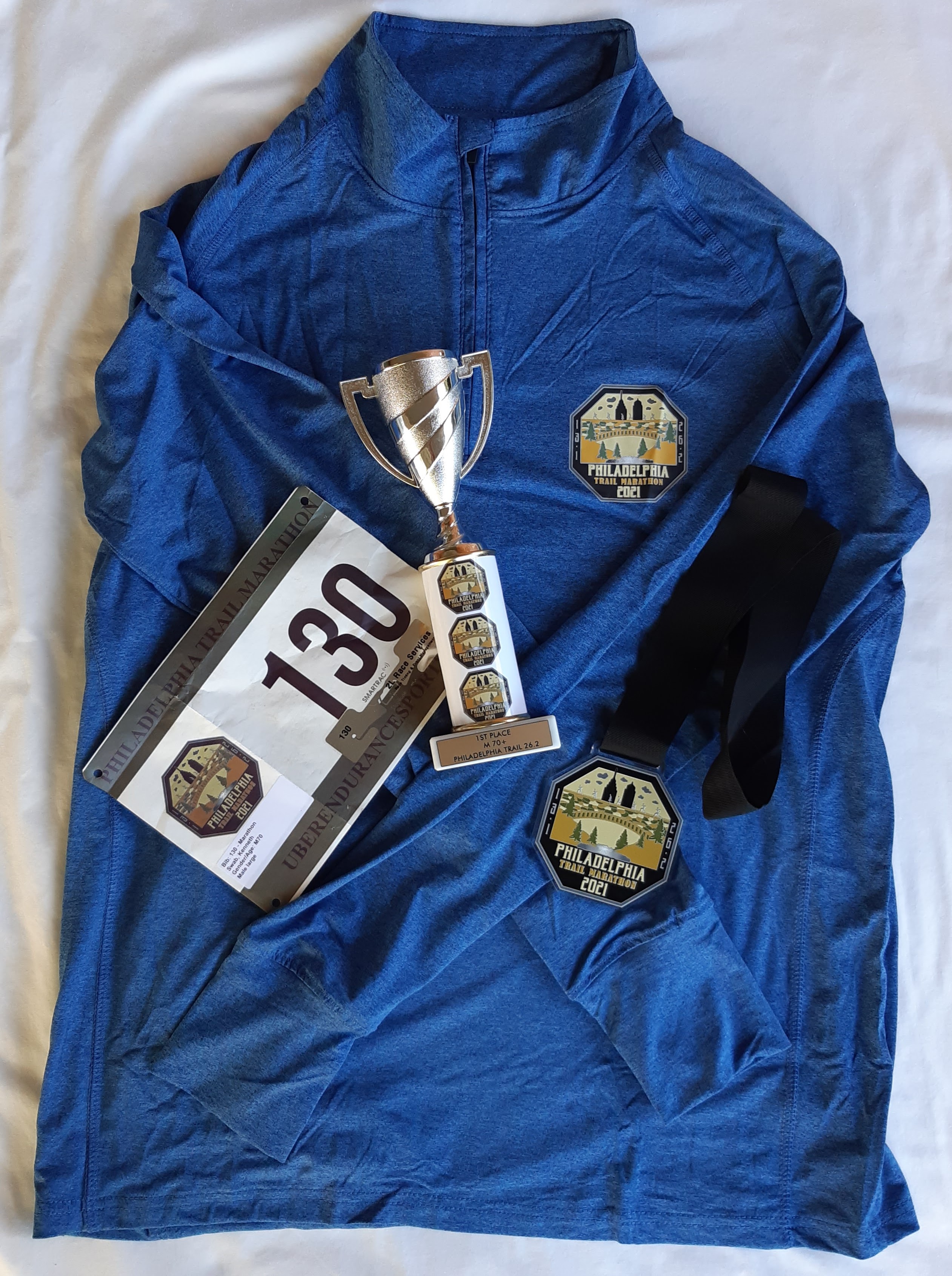
| Swag: Quarter zip, medal, bib and AG trophy |
![]() |
| Boulder Field |
Still Funny After All Those Times
![]() |
| Emaad and I at the start |
Emaad is about ready to throttle me and we have only gone a few miles at the Boulder Field 50K. Each time we are passed by another group of runners I can't help but tell a joke that my grandson loves: "Why should you never run behind a car?" But I can't help myself. It's too good not to tell runners.
We started out with perfect weather that will persist the entire day. Trail conditions are not perfect, however. The remnants of Hurricane Ida dropped a significant amount of rain on Hickory Run State Park two weeks earlier and rain on Wednesday has left parts of the course wet.
And "wet" means that a half mile of gentle uphill around mile two means there is water slowly running down the single track of the trail. Some of the areas at the bottom of descents are boggy. It isn't really a question of if you will step in muddy water, but when. Just embrace the inner child and splash through.
Since the course is a figure eight we return to the start/finish at mile 12 and can change socks and shoes for the 18 mile second part. "Don't bother," a runner who has run the race previously says, "the second loop will be wet."
Hickory Run
![]() |
| Hickory Run with AS 1 and 2 on far side |
After about five miles of up and down, we come to the Hickory Run crossing. Normally it would be on a wooden bridge, but Ida ripped the railings off the bridge and the park ranger has required that it be taped off with yellow caution tape. Crossing means splashing through the knee deep stream. The water is a bit cool, but it washes the mud off.
The first aid station (mile 5.1) is set up on the far side of the creek and the volunteers are frying bacon and making grilled cheese sandwiches, cut into quarters, along with having the usual cookies and other things junk food so loved by trial runners. Because of the pandemic, many of the items are pre-wrapped individual servings and the cooked items are set (mostly) in individual serving cups. I pry a grilled cheese open and stuff bacon into it and walk on. Emaad, still at the aid station calls me back, as I've headed in the wrong direction.
Trail Etiquette
"On your left," I say, the universal trail request that the slower runner ahead move to the right so someone can pass. On single track that may mean stepping off the trail briefly, or waiting for a place where one can move over.
But I'm surprised when the response is a snapped, ""I'm over as far as I'm going." I hold me sometimes hair trigger temper in check and maneuver around without saying anything. Emaad later tells me that the runner said the same thing to others who were trying to pass. It's a rare trail runner who is impolite, so this is a first. We will pay it back - in an appropriate way - hours later.
![]() |
| Lehigh River Valley Overlook View (Mile 8) |
The Best Aid Station
Finishing the loop back to aid station 1 (aka aid station 2 (mile 9.9) approached from the opposite direction) there is a steep downhill with several switchbacks. As I've gotten older, all but the most gentle downhills, and pretty much any technical ones have started to become a greater concern and I am going slower and slower on them. I fear tumbling down them or worse still, imagine myself going over the edge and rolling down the incline. What used to be the mantra of walk the uphills and run the flats and downhills is now walk the uphills and downhills and run the flats. The survival instinct has overcome the competitive instinct.
![]() |
| Grilled cheese, bacon and fried potatoes at AS2 |
A short stretch on an unpaved park road takes us back to the first aid station. As an additional treat the volunteers are now frying potatoes in the bacon grease! I tell them that this is a better aid station than the first one. Puzzled, they point out that it is the same one. "But now there are potatoes cooked in bacon fat!" I point out. "The first station didn't have that."
Several runners decide that they will navigate the railingless foot bridge across the creek. And I follow suit. After going a few hundred yards I realize that I left my water bottle at the aid station and have to backtrack to get it. The aid station workers offer some more bacon which I willingly accept. Yup, the best aid station.
![]() |
| That says it all. |
In a short bit we are on the Shades of Death Trail, following a stream uphill. The trail is very rocky - more rock than dirt - but it is along a stream and takes us to a picturesque waterfall. We briefly lose the trail, but the course has been well marked and we spot a pink ribbon where we should be and reroute to it. In a bit we are done with the Shades of Death and reach aid station 3 (mile 12.5) at the start finish.
![]() |
| The highlight of Shades of Death Trail |
Emaad changes shoes, I change my shirt and use the facilities and we head out for the second part of the course.
More Rocks, More Roots, More Water
We skirt Sand Spring Lake, follow the course through a disk golf course and a campground, and are back on a trail. And like most of the trails, it consists of rocks and roots, and in places, running water or mud. This part of the course has less elevation change (two-thirds of the elevation change is in the first 12 mile loop) but no less technical trails. We push on, looking for Aid Station 4 which my cheat sheet says we should have reached and cross under the Pennsylvania Turnpike. Finally, over a mile beyond where I had thought it would be, is the aid station.
Or Maybe the Best Aid Station
Approaching the aid station (mile 16.5) on the Stage Coach Road I call out to the volunteers, "Whiskey for my men, beer for my horses!" It's the right thing to say, as the volunteers swiftly produce a can of Montana 1 IPA that is shared (in individual cups, of course) amongst us. What is a beer from western Montana doing in the middle of Pennsylvania? We get the story - it involves a cross country trip - and after giving thanks, we are on our way down the Stage Coach Road, but just for a bit and soon turn off onto the rocky and rooty (well, that was no surprise) trail to head toward the Boulder Field.
![]() |
| Rocks, roots and trees most of the day |
And in a few miles, and more rocks and roots we reach the Boulder Field. Surprisingly, hopping from boulder to boulder is easier that dealing with all the smaller rocks on the trail. We refuel at the aid station (mile 19.3) on the far side of the field and head off onto the aptly named Stone Trail. More rocks, fewer roots, more water. And from there onto the Boundary Trail - straight, and full of rocks and roots.
We cross Fourth Run, where stones allow us to mostly keep our feet dry. The double track dirt road is pretty runnable but we are in no hurry. I've computed that any chance we had of finishing in under 9 hours has pretty much evaporated given the time and distance remaining. We pass a pair of runners and then one of them passes us back. It's rare in a race with less than 200 runners to pass someone 20 miles in.
Lions of the Serengeti
Something in being repassed stirs me. I tell Emaad that we will run a minute and walk a minute. After all, we have been doing a lot of walking, and the mild weather has not been sapping. We run and pass the runner. We walk and don't get caught. We run again. And repeat.
The course goes downhill gently and then heads under the Pennsylvania Turnpike through a tunnel carrying Fourth Run. There is enough water in the stream that keeping dry is not an option, but it is only a few inches deep. The other side is a continuation of the unpaved double track road and we keep to our new routine.
We see a couple more runners ahead. It's been years since I've had the feeling, but I'm ready to play the mind game "lions of the Serengeti." I'm a lion and the runners ahead are antelope. I'm going to hunt them down. It may take awhile but I'm a patient lion. Each step, every passing minute brings me closer. And when I have caught up, the lion has conquered the antelope.
Now, up ahead, we spy a single runner. We recognize the runner would not not step aside earlier in the day. Now that runner is prey for the lions. It is wide here and no need to ask permission or offer apology for passing. Normally I would have a chatty word for a fellow runner. Not this one. We pass the runner without a word or a glance.
Game On
We reach the sixth and final aid station (mile 24.6) a mile sooner than I expect. The volunteers are cheerful and encouraging, telling us that we only have five miles to go. I'm a bit confused as I thought we should have six miles to go. And then I remember what I was told earlier - GPS geometry. All the ascending and descending has the GPS reading short.
And so if we want to be under nine hours we have about 90 minutes to go five miles, not six miles. (The GPS will claim it was 5.9 miles). That is a world of difference. We feel good, we have a grassy trail along a powerline cut ahead, some rocks and roots and then paved park roads to go. It's doable. I have a goal.
I share my enthusiasm with Emaad. He's game but his knee is starting to bother. We go on together for a bit and then I tell him that I'm going ahead. No more one minute on and one minute off, it's just go as long as I can before taking a break. Even the technical sections and uphills are met with power walking. There is a steep downhill with switchbacks that do get my respect and attention.
There is a road at the bottom. I look in vain for ribbons and see none and a note of panic starts to creep in. But I look down and there are white chalk arrows on the ground to point the way.
I haven't gone far and a runner catches up to me. It's the leader of the 100K which started two hours earlier than the 50K. We exchange greetings and just past me he starts walking the uphill. The lion within is aroused and I pass him back. My lead lasts for a few yards until he resumes running, passes me and is soon out of sight. Sometimes the lion is taken be a stronger lion.
I've very confident that nine hours is well in hand, unless I get off course. And now along the road to the finish I search frantically for pink ribbons, terrified that I'll miss a turn. I slow down, weave into the road to be able to see further down, scan the woods for trails and ribbons in case I should have turned.
But it is unnecessary. I'm on course and the finish is in sight. I cross in 8:42:43. I'm DFL in my age group, but since I'm the only one in my age group, I'm also first. Emaad finishes five minutes behind.
![]() |
| Finish in 8:42:43 (Photo by Daniel Govern) |
Punch Line
Oh yeah, why should you never run behind a car?
Because you will get exhausted.
By the Numbers
Overall, I was 147 of 169 finishers (202 registered yielding 33 DNS/DNFs), 99 of 108 males, and the only one in my age group. My overall pace was 17:07 minutes/mile, but I ran the last 5.3 miles from the final aid station at a 14:33 pace, just a bit slower than my pace for the first 5.1 miles from the start to the first aid station. And the oldest finisher. Nothing wrong with old and slow.