Monday, November 21, 2022

Patapsco Valley 25K - October 29, 2022

Back to Running
I fractured a bone in my left foot on July 11when I missed a step in the house.  No surgery was necessary, but I spend eight weeks in a cast, which didn't come off until September 14.  While I could walk, I didn't resume until October 3 when I managed four miles on the treadmill. From then I ran nearly every day, usually 3 - 6 miles per day. Uncertain of my stability on trails, I bought a pair of Leki trekking poles.

Emaad had signed up for the two-loop Patapsco Valley 50K on October 29.  Looking at the course map I recognized that I have run on much of it while running the Maryland Heat Runs in 2015 and 2019. While it is nice to know what the course offers, in this case I know it offers plenty of steep up and downs. I know that I'm not in shape to take on the 50K, but one loop for 25K with a generous cutoff seems doable, particularly with trekking poles.  I sign up.

I get one ten mile run on trails in with Emaad on October 23. It's a chance to get used to the trekking poles. 
Typical Single Track

Race Day
I drive Emaad and myself to the race start at Baltimore County Community College on the edge of the the park.  The weather is just about perfect - maybe a tad warm.  We chat with fellow runners and he goes off with the 222 50K runners at 730.  The 25K starts an hour later. I chat with friend Gretchen as we wait, and once we are off she is quickly gone.

We run a few hundred yards on a grassy field before getting on the single track trails in the park. It is a bit of up and down, but mostly down, as we need to wind up at the Patapsco River before crossing over to the other side of the valley.

As time goes on the runners spread out and I move further back in the field. The poles help on the steeper rocky and rooty downhills, and at one small stream crossing, save me from slipping from a rock.
Tunnel under train tracks (Mile 6)

Memories of the course come back from the Maryland Heat Races although we are largely running the trails in the opposite direction. After about 3 miles there is a water-only aid station, but my pack is pretty full so I thank the volunteer and go on.

Near the river we cross under the railroad tracks and in a short while come to the first full-service aid station.  I get my usual fill of cookies and M&Ms and eat them while going on.  

We cross the river on a road, pass the Avalon Picnic Area (start-finish for Maryland Heat Races) and turn uphill on the trail.

Plenty of climbing and descending small valleys are in store, but I'm in no hurry and am mostly walking anyway.
John Smith Marker (about mile 8)

On top of a ridge overlooking the river I stop to look at a monument by the side of the trail.  "Capt John Smith" on one side, and "to the cross hath been discovered A.D. 1608" on the opposite.

I'm a bit confused as are several other runners. We are a couple of hundred miles from Jamestown, Virginia. the only thing I know about John Smith is the story about Pocahontas. While much about that story is unclear, disputed or romanticized (or all three), it turns out that Smith did visit the place where the monument sits. 

A year after arriving in Virginia, Smith extensively explored and mapped the Chesapeake Bay, apparently looking for a passage to the Pacific Ocean. The Captain John Smith Chesapeake National Historic Trail follows his journey, including his visit up the Patapsco to that site.
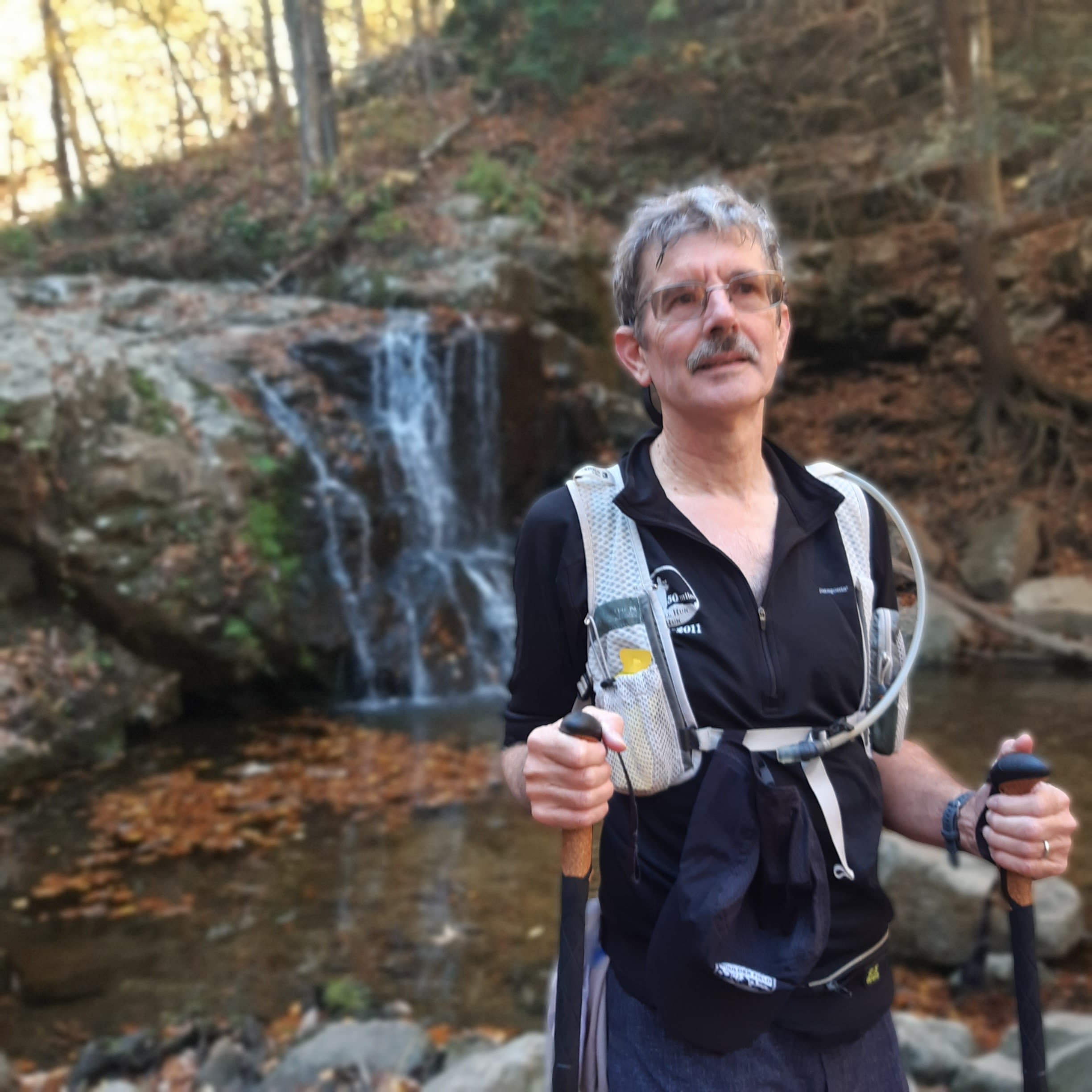
Cascade Falls (mile 10)

Onward I go (plod?).  I pass the log by a now-dry intermittent stream crossing where I lay down during the 2019 Maryland Heat Race to recover from the heat. (That picture is worth a look if you want to see what not-fun running looks like.)

Downhill leads to the picturesque Cascade Falls. There are two photographers there, both with cameras on tripods, on either side of the pool. I wonder why they chose the side they did.  Many other people are also taking pictures at the photogenic location and I can't resist either, asking a fellow runner to take mine. 

Crossing over the stream outlet of the falls to get to the trail on the other side requires navigating over medium size rocks.  Near the end of the rocks a father is helping his pre-teen son get from rock to rock while his mother and a couple of other children wait. The father is describing the rocks ahead and instructing the son where to feel for his next step.  The boy reaches out with his rubber tipped stick and feels the contours of the rocks.  He is blind. Courage, trust and love are together in that moment.
 
In half a mile I get to the next aid station, refuel with some bacon and candy and return to the trail for more up and down.

Ahead of me are "Tweetle Dum" and "Tweetle Dee," a pair of women with matching shirts with the afore-mentioned logos on them.  I press to keep up with, and even catch up to them.  We pass a large group of women out walking all wearing matching shirts proclaiming their support for abused women.  One has fallen, and some of the others are gathered around her, but she isn't hurt and doesn't require assistance.  There are two hikers that I repeatedly pass, and they repeatedly pass me, when I stopped at the falls, and the aid station. 

I finally catch up to the Tweetles, as I dub them, around mile 12, and see Gretchen just in front of them. Another runner, Nicole, is with her.  Mercy sakes alive, looks like we got us a convoy! 

Along the Bloede Dam Trail, to a right on Ilchester Road, another right past the second water-only aid station, across the Patapsco Swinging Bridge onto the paved Grist Mill Trail and a sharp left back onto the trail.  We are headed away from the river, so it is uphill. And more uphill.

We pass Ilchester Rocks, where rock climbers practice their skills (although there are none today), It's then a long downhill on the Sawmill Branch Trail, where there is a very steep boulder drop that requires me to go bottom first, and then a 300 foot climb out.

Somewhere along here Gretchen and I decide that we should finish together. Maybe it is a way to bank any competitive fires we have, or a mutual decision to be companionable, or a mutual decision to be compassionate. In any case, even as we leapfrog a bit we stay together. We come out of the woods together, and as we cross the field we join hands and cross the finish line together.

Post-Race and Results
I finish in 4:49:24  for 162/186 overall, 106/114 males and 1/2 in my age group.  Gretchen also wins her age group, even though there are no prizes.

Waiting for Emaad I go off to Subway and get a foot-long which I devour without any problem. Picking him after his 50K finish we go off to Hysteria Brewing Company for some refreshment.

Swag: Shirt, tote bag, magnet, bib and medal


Monday, August 8, 2022

Finger Lakes 50s 50K - July 2, 2022

Running by South Burnt Hill Pond
(photo by FLRC)
 Mud or No Mud?

I spend Friday night worrying about rain.  Although the weather in the Finger Lakes region has been dry, race reports on previous Finger Lakes 50s indicate that the course can be wet all the time, and rain can quickly add water to the stream crossings on the course. Light rain falls overnight while I sleep fitfully.

The race fills up quickly, and I registered on January 1, when registration opened (and closed). It will be the second time running the race, which I first ran in 2007.

Up at 5 a.m., and there is a bit of mist in the air; maybe some intermittent raindrops as well. Sandy drives me from our Watkins Glen house to the start at the Potomac Group Campground in the Finger Lakes National Forest. A deer dashes across County Road 4 on the way.

Sandy drops me off and I struggle to put on my 'emergency' plastic poncho for the walk to the campground.  It isn't exactly raining but it isn't exactly not raining either. There's no cell service there so I can't check the radar.  Finally I decide that since the forecast calls for improving conditions as the day progresses, I can go without. But I wear a hat in case. And gaiters to keep mud out of my shoes (realizing as I put them on that I didn't attach velcro to the heel to secure the back of the gaiter). I loan a trash bag to another runner so that he can keep his bag dry in case it does rain.

The cowless first pasture.
Don't' Let the Cows Out! 

The race motto is "Don't Let the Cows Out" as we will run thru three cow pastures.  The last minute instructions from the race director emphasis that this calls for ditching the usual politeness to following runners.  "If they are not within touching distance of the gate," he says, "close it. We can't have cows escaping if this race is to continue."

The course is a 16.5 mile loop in the Finger Lakes National Forest. One loop for the 25K, two loops for the 50K and three loops for the 50 miler (plus a "baby loop").  And yes, that's 33 miles, not 31.1 miles for the 50K, but the purpose is to get the 50 milers almost finished (49.5 miles) in 3 loops. Anyway, the distance is what the race director says it is.

Down and up trail

At 6:30 a.m. the 50M and 50K runners start. The 25K runners will start an hour later.  Down gravel Potomac Road we go before turning right and onto single track. We cross a road, run along a pasture fence line, then thru a gate into the pasture. No cows are in sight and it appears that none have used this pasture for awhile.  We exit on the far side, being sure to close the gate. Then it is a long downhill on the unpaved Mark Smith Road. I take it easy on the downhill as I have no interest in trashing my thighs early.

Don't Let the Cows Out!

The weather is pretty good for July 2 - it's overcast and the temperature is warm but not oppressive. And there is no rain.  And an even greater surprise is that the course is pretty dry.  This is due to the drought conditions that the Finger Lakes have been experiencing. The bit of rain the night before has settled the dust down without creating mud or raising the little or no water in the streams on the course.

Close the Gate.
From the Morgue Aid Station on Mark Smith Road, the course turns onto the Gorge Trail, going upward before turning downhill to the South Beach Aid Station. The trail skirts a pond, but it isn't swampy. Then it is more downhill on the Interlaken Trail before looping back up to South Beach on the South Slope Trail. (As far as I can tell, the aid station names are apropos of nothing.) 

From there it is north on the Interlaken Trail, crossing Matthews Road with nice views of Seneca Lake to the west while crossing another cow pasture (a rare place with a cell signal)  to a right to the Library Aid Station on Burnt Hill Road. Then into the forest again, with a steep and scary descent on the aptly named Ravine Trail, followed by the inevitable uphill that follows a descent.

Then past the horse camp and north on the Backbone Trail. On the trail some rain starts to fall and I switch my hat around for backward to forward.  But the shower doesn't last long and the Outback Aid Station, is next to the third pasture of the day, this one with grazing cows. On the far side of the pasture two cows are near the gate grazing. Or are they just waiting for someone to let them out? I make sure to close the gate behind me.

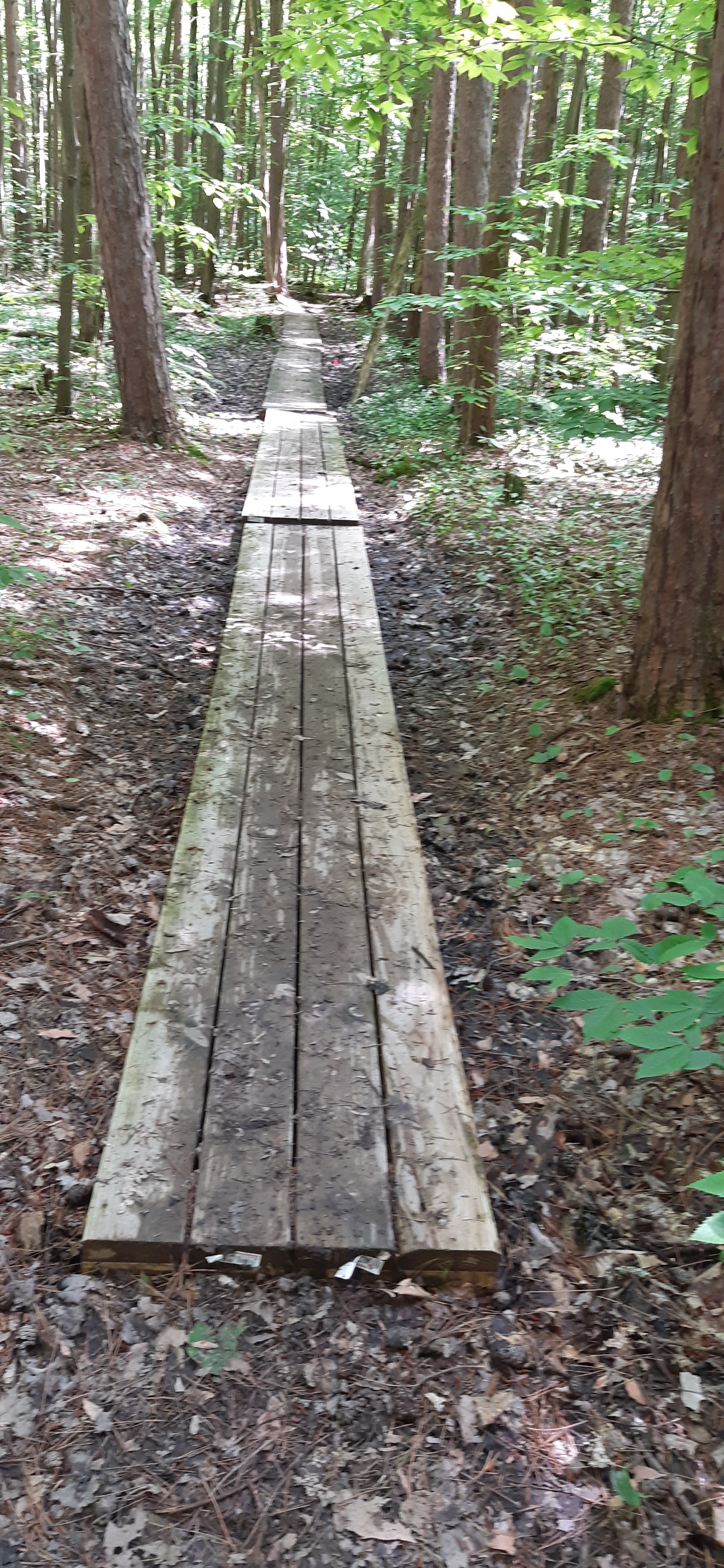
This is the homestretch (a couple of miles anyway) back to the finish at the campground.  Stretches of pine forest, some boardwalks to run on, another pond or two to skirt, and in 4:04:24 I've completed the first lap.

Alongside a pasture on the Burnt Hill Trail

Second Lap

I change my shirt, taking off my 2007 FL50s shirt, ditch my hat and head out on my second loop.  My goal is to finish the race in 9 hours, so I feel good about having close to five hours for the second loop. No hurry, no worry, even as 50 milers on their third loops speed by me.

Every Runner Has a Story

I'm in no hurry (from the start, not just the second loop), and take the opportunity to chat with other runners as I can. Some of these conversations happened on the first loop, and not necessarily in the order presented.

Alongside South Burnt Hill Pond

I run a bit with a runner from Pittsburgh and tell her about running Hell Hath No Hurry there. She points to her visor - it's from HHNH.  We trade stories about our experiences at it and discuss the race director, Peter K, who is my first cousin, once removed. My first cousin is the grillmaster at the race.

A bell in memory.

One woman tells me this is her first race. Do you mean your first trail run, or first marathon, or first ultra I ask.  No, my first race, she replies. I've never entered a race before, she says.  She is a triathlete, so she has done runs as part of those events, but never just entered something that is a solely a running event.  She says she is enjoy the event.

On the Backbone Trail during the first loop I come upon a couple walking ahead. One of them is limping.  I express concern and offer salt tabs or ibuprofen if it will help. The runner says its OK, that while he won't be able to run, they are close enough to the campground that they will make the first loop cutoff of five and a half hours and will be able to walk out the second loop.

Outback Aid Station
The Horses Smell the Barn

On the second pass through the pasture by Mathews Road I spot the cowbell hung with colorful flags from a tree. I ring it as I pass, as it was put there by the Finger Lakes Running Club in memory of a member who had passed, but who loved running there. We runners are urged to ring it for him.

Boardwalk
I linger a bit at the Outback Aid station, in no particular hurry as I eat, chat with the volunteer and enjoy the view. A women runners comes hustling thru, not stopping for anything. The volunteers yell at her for her bib number so they can log her passage. "Nine," she shouts over her shoulder.  She is Maura Tyrrell, and is on her way to being the first female (sixth overall) in the 50 mile race.

It's a bit of a reminder that I, too, should get moving on. Thru the cow pasture, but the cows have moved on, into the piney woods, over the boardwalks and around the first of the Potomac Ponds, where people are floating on tubes and rafts. 

I come across a woman hiker I saw earlier in the day when we had exchanged pleasantries.  She tells me that I only have 3/4 of a mile to the finish. I look at my watch (I had shut the GPS down at the Outback Aid Station to conserve what little battery life remained), do some mental calculations and figure I can finish under nine hours. Since I haven't been hurrying the second loop, I have plenty left in the tank, and get my giddy-up on (although it might not have seemed so giddy-up to a dispassionate second party observer). A brief moment of confusion near the end is resolved by people pointing me in the right direction, and I finish in the second loop in 4:48:50, for a final time of 8:53:13.

I have more than an hour to wait until Sandy arrives to pick me up, so I take my time sitting under a pavilion, watch other runners finish, chat with people, and get the post-race meal of BBQ tacos and salt potatoes. There is no beer available (officially), but there is non-alcoholic Athletic Brewing Upside Dawn. It turns out to exceed expectations so I ask for a second.  And as I have time, later I have a Free Wave IPA. Hydration following a July ultra is important for recovery, after all.

Post-race BBQ tacos, salt potatoes
and non-alcoholic beer
Results

I finish 65 of 75 (and 8 DNF), 40 of 41 males and 2 of 2 in my age group, only 1:27 behind the only other 70+ runner (he's 73 to my 71). 

Swag: Shirt, Slate Coaster, Bib

Tuesday, July 12, 2022

Night Train 50K - June 25, 2022

Pre-race hydration
Hydration Is Important
Emaad and I arrive in Farmville for the Night Train 50K and its 5:30 p.m. start about 1:30 in the afternoon. The day is warm, with temperatures in the upper 80s (it will be 88 at race time) and the race starts in about four hours. We know what we need to do before then.

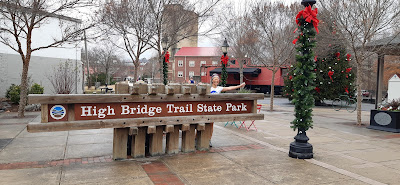
Runners know that hydration is important. Dehydration can lead to cramping and nausea, mental confusion and contribute to heat exhaustion and heat stroke.  We have been drinking water and iced tea on the three and a half hour drive, but now it is time for some more fluids.  Our first stop in Farmville is at Three Roads Brewery right on the High Bridge Trail and next to the old Farmville Train Station, which will be the location of a race aid station. I get a High Bridge Helles Lager for its low (5.2 ABV) alcohol content, and get a four-pack to go.

Hydrated and refreshed we go to Charlies Waterfront Cafe for lunch, which for me is a chicken Caesar salad and an iced tea (more hydration). We finish about 3:30, go check-in to our hotel, take a brief rest and drive the 15 minutes it takes to get to the start at Camp Paradise, an earthen Civil War fortification erected by the Confederates to defend the high bridge over the Appomattox River.  It was paradise as the locals treated the soldiers well (and better than being besieged by the Union in Richmond and Petersburg). Paradise ended abruptly when Union troops, in pursuit of Lee's army fleeing west, arrived on April 6, 1865. 

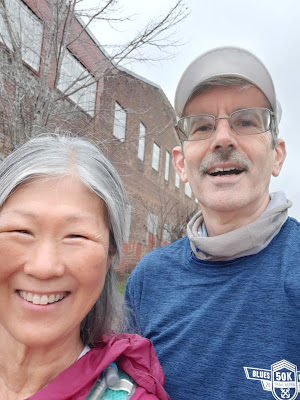
Emaad and I at the start
Westbound
At 5:30 p.m. the sun is still high and the 114 runners in the 50K head out (104 half marathoners and 35 5K runners will start later). In only a couple on minutes we are on 2400 foot long High Bridge across the Appomattox River 125 feet below. There is plenty of chances to chat with our fellow runners as we travel the five miles toward Farmville, including a couple pushing a toddler in a stroller.

A runner tells me of how she had to be carried off one race by a couple of runners when she was suffering from hypothermia.  She was hospitalized for several days but was more concerned that a runner who helped save her was a DNF for missing a cutoff as a result of rescuing her. Such is the mindset of the ultrarunner.

Farmville
The High Bridge trail takes us past Three Roads Brewery where a woman sitting having a beer cheers us on. "Wish I could have a beer," I say.  "Want a sip?" she replies. "Sure," I respond, veering off the trail toward her.  "I'm vaccinated," I note, taking a sip from her glass. "That's OK," she replies. Emaad thinks that I'm crazy and that she probably poured the rest of the beer out.  I doubt that, but I regret that I forgot that I had a collapsible cup in my pocket, as the race is cupless.

Early on
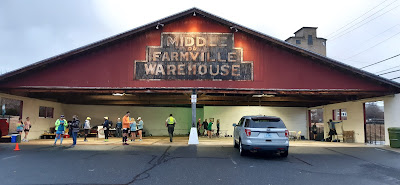
We stop at the first aid station at the old Farmville Train station next door to the brewery (mile 5.7; ET 1:09:57) for some quick refreshments.  The part of the course is that same that I ran at last December's Freight Train 50K (report here) so it is familiar.  The main difference is that the trees are leaved out and provide some shade from the still-high sun.

Tuggle
We reach the Tuggle aid station (mile 11; ET 2:19:23). I'm pleased with our progress as I have a goal to finish in 7:30, about 7 minutes faster than I did Freight Train. According to my pace card, I'm about 15 minutes ahead of the pace I need to accomplish that, but I try to caution myself not to go out too fast.  In long races banking time does not work, conserving fuel does. Still it is hard to throttle back when you feel good.

Emaad is starting to lag behind, but I tells me that he is fine physically, but is mentally in a dark place.  He tells me to go on.  Since I have a goal, I do.

Sunset beyond Tuggle
Prospect
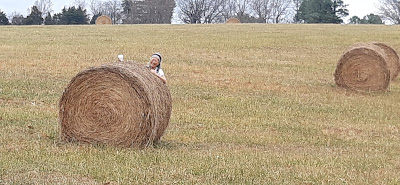
I recognize the field with hay bales where Caroline had me take her picture in December. Now the sun is beginning to set over that field and the (new? same?) hay bales. A bit further along I pass where the turn around was for December's 50K.

The light is starting to fade, but not so much that a light is needed. I get to the Prospect aid station (mile 15; ET 3:12), go to my drop bag, dispose of my hat, change into a dry shirt and extract a 60-lumen cane light that I found in a cupboard at home and stick it on my finger but do not turn it on.  I go the additional mile to the turn-around at mile 16. It is getting dark but the last bit to the turaround had an open field beside it and there is enough light to get to the marking the spot without using the light.  A check of my GPS watch and the pace card shows I'm still 15 minutes to the good.

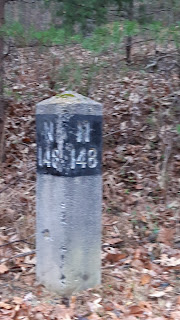
Old RR mileposts on the trail
About .4 mile back toward Prospect I greet Emaad on his way to the turnaround.

Return to Prospect
Back at Prospect aid station (mile 17, ET 3:44) I sit down, go thru my drop bag and select a knuckle light to carry for when the cane light gives out. I decide not to bring a second knuckle light, my head lamp or spare batteries. 

By now (9:15 p.m) it's dark. The sun set about 8:38 p.m., the half hour of light that is civil twilight is over and the sliver of a moon provides no light.  The trail is unlit and there are few buildings or dwellings by it.  And it does not take more than a mile or two for me to realize that the cane light is providing barely enough illumination to distinguish the darker center of the trail from the slightly lighter, more trod portions on either side of the center.  But I resist using the brighter knuckle lights as I want to save them so I have light later on.

And I'm starting to get tired. At 9:30, barely a mile after leaving Prospect I text Emaad, "Ditching send and a half hour [goal]. Cramping pre-cramping. You'll catch me."  My calves are tightening up from all the repetitive motion of running on a smooth, flat surface.

Tuggle Revisited
I arrive at the Tuggle aid station (mile 21, ET 4:49) feeling exhausted.  I'm 6 minutes ahead of my target pace for a 7 1/2 hour finish, but I've given that up. I sit down and text Emaad again (10:18 p.m.), "I'm at Tuggle. How are you doing."  If he is near, I think I might wait for him. No response so I try calling. No answer.

Emaad on High Bridge
I get up and get going again.  I switch to the knuckle light, putting it on the low setting to preserve it, but I'm still concerned it may not last to the end.

Emaad texts that he is at Tuggle at 10:32.

Ahead of me I see a pair of lights. There is a pair of runners ahead.  If I can catch them I can shut off my light and rely on theirs.

It takes a bit but I finally catch them, partly because they had stopped to look at a black snake partly on the trail. They are amenable to me relying on their light.

Having better light is useful, as there are occasional small frogs on the trail and seeing them is better than stepping on them.

Stories start to be exchanged. Michael, who is setting the pace for Christie and me by deciding when we should run and when we should walk (we are mostly walking; running when he fears he might cramp up) reveals that he did the Moab 240 in 2019. He tells about the hallucinations he had there: the Indians silently watching from mesas ("like a John Wayne movie"), the people cleaning the trail where he was running ("who are you thanking?" a fellow runner asked him) and the "rock people," who silently guided him back onto the trail when he was off-course and headed toward the edge of a cliff.

Sign in Farmville marking the trail
Farmville Again
We reach the Farmville aid station (mile 26.5; ET 6:07), thank the volunteers, refill our water bottles, eat a couple of slices of oranges and head out.  I text Emaad at 11:42 p.m. that I'm passing thru Farmville.  Eight minutes later he responds that he is 10 minutes behind me.

I say out load, partly in surprise, that I'm still five minutes ahead of the 7 and a half hour pace. "You won't make it," Michael advises. "I know," I reply, as reality returns.

I turn on my light. We press on, and I gradually pull ahead, as I can walk faster than they can. We spy a rabbit as we leave Farmville, the only wildlife (other than the frogs) I see the entire race.

I actually catch up to a runner or two, and get passed by several. Sometimes I turn off my light just for the fun of running in the dark, or seeing my shadow ahead of me cast by runner's lights behind me.

Crossing High Bridge, I turn off the light so that I can enjoy the the lights of the thousands of fireflies below in the woods beneath the bridge.

Even with the finish in sight I'm walking. My calves are horribly tight. A runner goes by and I don't care.

Fifteen yards from the finish another run draws abreast.  Somewhere in the primitive part of my brain the urge to compete bubbles up. "Let's race to the finish," I say, and we do our best imitation of sprinting - to dispassionate observers probably little more than a waddle. But I cross the line first, accepting my finisher's coaster and plunk down in the nearest chair past the line. My time is 7:37:02.

Emaad finishes two and a half minutes later. Michael and Christie are five minutes further back. The woman with the stroller finishes in about the same time, the child sound asleep.

Results
I finish in 7:37:02, seven seconds faster than I did Freight Train.  I'm 85 of 116 overall, 58/74 males and 1 of 3 in my age group. One male and one female older than I finish.

Swag: shirt, coaster, sticker and bib


Thursday, May 26, 2022

Farm Park Challenge Marathon - May 7, 2022

 Preparation

Having run Farm Park Challenge last year (report here), I know that one parks right at the start-finish so one's car becomes one's drop bag. And since the forecast calls for rain and temperatures in the 50s at the Agricultural History Farm Park, the car provides a dry - and large - drop bag. Since I'll be running five laps of the course, I'll pass my car four times (and at the finish) so I stock it with six shirts, an extra poncho, four pairs of gloves, four hats, extra buffs, towels and bandanas. And dry clothes for the finish.

Early on not too muddy
I arrive in ample time, park, pick up my bib, and sit in the car to stay dry and warm before the less than one minute walk to the start at 6:55, a five minute head start on those running the challenge races (run each 5.18 mile lap in an hour, then start the next lap at the start of the next hour).  At 6:49 I glance over to the start and realize that I mis-read the start time - it's at 6:50. I leap out of the car, and dash for the start line as the RD is counting down "10, 9, 8 . . . ," reaching it at "4." And we are off, and I'm out of breath, so I have to immediately start walking.

Back and Forth

The course is an out-and-back mostly on the the Upper Rock Creek Trail.  It is mostly new territory for me and is a mix of grassy surface, some double wide track, a bit of paved trail in the middle, and a small stretch of single track.  Three small bridges cross Rock Creek and two smaller streams.  The rain is light but steady, and the course gets muddier and more slippery as the day goes on.

At the end of the first lap (1:03:29) I go to the car, change both shirts under the damp poncho, and change my gloves and hat.  

The second loop is much like the first, only the course is getting more slippery.  I chat a bit with Monika B., who is only running two loops as she has other commitments for the day.

In the third loop with
the second poncho and third hat.
At the end of loop 2 (1:10:52) I revisit the car.  The poncho was water resistant, not water repellent, and after over two hours in the rain it is soaked.  The gloves I had put in its pocket are also soaked, so they, too, go. I change shirts again.  I put on the cheap, water repellent, plastic disposable poncho.  It isn't stylish (but a women tells me she can see me on the course because of its yellow hue).

Approaching the end of the third loop (1:20:13) my hip starts to hurt.  There is no obvious reason for the pain, but none the less, it is there.  I briefly think of dropping but decide to slow down, both mentally and physically. Back at the car I take a pair of ibuprofen and decide to walk for 20 minutes. That's how long I figure it will take for the pain reliever to kick in.  Walking awhile I start to make some calculations. Twenty minutes of walking will be about a mile.  That means I would only have another 1.5 miles of so to get to the turn around.  That's walkable, and walking back the 2.5 miles would at least give me four loops, I figure.

The bridge over Rock Creek
After 20 minutes or so I tentatively try running. No pain. I don't overdo it (I never do anyway) but I can get back to my usual mix of running and walking.  While the rain is lessening to a mist, the course is becoming increasingly muddy and slippery.  There are no steep inclines, but the slight downhills are treacherous and places where the trails are canted I sometimes slide sideways.

I chat with a women from Texas who is planning to take advantage of the generous ten hour cutoff to finish the race.  She and several colleagues are on an East Coast tour to rack up a number of states for their 50-State quest.  Maryland today, then a race in New Jersey of Tuesday, then Rehoboth for Delaware on Saturday then on to Connecticut for a fourth.

It's a stream trail
Finishing the fourth lap (1:26:19) I grab a slice of pizza and an avocado-sweet potato wrap and head to the car for another change of shirts. The rain has ended so I ditch the poncho, get rid of the gloves and change hats.

Nothing to do now but repeat what I've been doing.  I run a short while with one of the challenge racers, who are on their sixth loop. He's new to trails, but even with the inclement conditions is enjoying the experience.

At the finish with muddy legs
and beer
Getting near the turn-around I catch a women running the six-hour challenge.  She thinks she won't be able to finish the lap under the required hour, but I urge her on, mainly because my computational ability is way off (a common experience of distance runners).  She does go on and is soon out of sight, but won't make the cutoff.

I get to the start-finish and am directed to the short grassy loop that adds the few tenths of a mile necessary to reach the 26.2 miles to make a marathon. The grass is wet but the water and leaves of grass wipe the mud off my shoes (see picture, left).

Midway through the mini-loop I catch up to a runner. It turns out that she has actually finished the race, but is running another mini-loop because Strava doesn't register that she has completed 26.2 miles. "I must have gone off course somewhere," she says. "Or maybe your device is wrong," I reply. "Don't let the machine rule you."

When I finish I collect my finisher's glass and two Waredaca beers, get another slice of pizza, and head home to wash off layers of mud.

Results
I finish in 6:25:20, good for 12 of 21 and 7 of 9 males. I'm the second oldest finisher (1 of 2 in the 70+ age group) and have a surprisingly good Ultrasignup rank of 55.05 (based on the winner's 3:36:12 time).

The conditions take a heavy toll on the challenge runners. Only 27 of 36 (75%) 3-hour challengers complete their laps on time; 10 of 27 (37%) of 6-hour challengers; and only a single 10-hour challenger out of 10 (10%).  In fact, only two other runners completed as many as seven loops.

Swag: Shirt, bib, mason jar glass,
two Wardeca beers

Friday, December 31, 2021

Freight Train 50K - December 11, 2021

Caroline at the trail sign in Farmville

Friends You Can Rely On
Following my November run at the Pass Mountain 50K, I decide that I should finish the year with a December ultra.  I search around for something reasonably close to home and find the Freight Train 50K on December 11.  Emaad declines to join me but I sign up anyway.  Prolific ultramarathoner and friend Caroline lives in Virginia and might be interested so I send her an email.  Within minutes she responds that she is now signed up.  Further email exchanges confirms that I will drive down the day before but that she will drive down on Saturday morning.

Weather or Not
Caroline and I at the start
December weather can be fickle. Fortunately, weather at race time Saturday is mild, with temperatures in the 50s with some wind. But good weather may not be the day's entire forecast - there is a front on the way with rain and dropping temperatures called for in the afternoon.  The issue will be when the front arrives and when we finish.

Let's Run
Start time is a very convenient 8:30 a.m. The 100K runners started at 7:30 to get ahead start on their day. Cut-off times are very generous - 17. 5 hours for the 100K runners, 16.6 hours for the 50K, particularly given the course.  The race is held entirely on the High Bridge Trail State Park. The trail is a 31-mile long rails-to-trails on a former Norfolk Southern right-of-way with a few very gentle grades, a well-maintained 10-foot wide packed dirt surface and the main attraction, High Bridge, which is more than 2,400 feet long and 125 feet above the Appomattox River.  The right of way was originally the South Side Railroad, which played an important role in the Civil War, as you will soon see.

Caroline and I trade texts and meet up at my car, parked across the street from the start-finish.  This is one of the great benefits of the usually-small ultra races, where small fields are the rule rather than the  exception. There will be 33 100K finishers and 137 50K finishers today.   She eats a donut that I brought for us and we cross to the start finish area.

The start-finish at the Farmville Farmers' Market
The race is a double out-and-back on the trail from Farmville, first running 8.2 miles to an aid station at Rice before returning to Farmville, then heading west for about 7.5 miles to a turnaround about a mile and three-quarters past the aid station at Tuggle and retracing our path back to Farmville.  The 100K runners go further on each leg, basically covering the 31 miles of the trail twice for their 100K.

Caroline heads across High Bridge
I search for a place in the Farmville Farmers' Market shed to leave my drop bag and put it down amongst some of the other bags. It has more than enough items, including long and short sleeve shirts, socks, trail shoes (in case I found the surface too hard for my road shoes), the rest of the donuts, gels, and random odds and ends.

Crossing High Bridge
The Way to Rice
After the National Anthem, we are off promptly at 8:30. Caroline seemingly knows every other runner and greets them all warmly.  We mostly run together and are always in sight of each other. We chat with other runners, and in a couple of miles come to High Bridge.  The bridge was the scene of hard fighting on April 6, 1865, as Union troops tried unsuccessfully to burn the bridge so that Robert E. Lee's retreating army could not get across it. They were repulsed and the following day, the Confederates tried to burn the bridge so that the Union army could not follow.  Union troops saved the bridge and the wagon bridge below High Bridge from destruction and the Union army was able to continue its pursuit.

Railroad Mile Marker
I run awhile with Caroline's friend Yancy and we discuss the action and other parts of the Appomattox Campaign.  After crossing the bridge we pass Camp Paradise, a Confederate earthworks formation built to protect the bridge and the scene of hard fighting on April 6.

We get to Rice, refuel at the aid station and head back toward Farmville.  The wind is picking up and crossing High Bridge I have to hang on to my hat.

Who Moved My Bag?
Back at Farmville (mile 16.4) I eat a slice of pizza and head for my drop bag.  I can't find it. I as a volunteer and tell him where I left it.  He points to a paper sign on the wall that tells me I left it in the pile of drop bags that was being transported, mostly for 100K runners, to the Tuggle aid station, 5.7 miles further down the road.  I'm chagrined, but at least the bag is ahead.  Still, I'm unable to replenish my gels or change my shirt as I planned.

Caroline plays among the hay rolls
On to Tuggle and Beyond
Caroline and I go on, talking about serious and light subjects. A couple hundred yards from the start-finish we pass the Farmville train station, where on April 7, 1865, Lee's army received supplies before Union troops arrived and the Confederates moved north. General Grant arrived later in the day and sent a letter to Lee asking him to surrender his army.

True dat - especially at mile 8
We run - and walk - along the trail.  It is a pleasant run, and unlike so many of the usual trail runs I'm used to, it is pretty easy. There are no steep climbs, no rocks or roots, no stream crossings.  One can run and look around, without worrying that a moment's inattention will bring one crashing to the ground.  And since it is December, the leaves are off the trees on either side and one can see the farmland and woods beyond the trail.

We reach the aid station at Tuggle (mile 22.1) and I open my bag to do what I had wanted to do at Farmville.  There is a road parallel to the road and I realize that this must have been the road that Sheridan's cavalry, under George Armstrong Custer's command took to get to Appomattox Station ahead of Lee on April 7-8, closely followed by Edward Ord's infantry, cutting off Lee's route of retreat and leading to Lee's surrender on April 9.

On we go from Tuggle until we come to a folding chair in the middle of the trail. It has a sign attached to it instructing 50K runners to turn around and 100K runners to go on.

The turnaround
We turn around and return to the Tuggle aid station (now mile 25.4) and continue back toward Farmville.

Now the wind is picking up again and low ragged clouds are racing ahead of us from the west. We catch up to a runner who is mostly walking. It's his first 50K and our chatter and companionship lifts his spirits and he begins to run with us.  

With about a mile or so to go I glance at my watch and figure that I may have a chance to finish in 7:30.  "The horse smells the barn," I tell Caroline and our new trail friend and I take off.  While I don't say it, I'm also increasingly concerned that the dark clouds behind us are moving faster than we are. Not exactly a sprint, but I'm determined that I will run and not take walk breaks.  But after a mile and with the train station in sight, I realize that I'm not going to make 7:30. And perhaps the reason is that, recalling the race instructions, is that the course is described as "a bit more than 50K".  

I finish in 7:37:09, good for 98 of 137 finishers, 59 of 74 males and 1 of 3 in my 70-79 age group.  And I'm not close to being the oldest. Besides the two other older runners in my AG there is a 81-year old finisher. Caroline is close behind me in 7:37:45.

The truth
Postscript
After a post-race slice of pizza, and some fellowship with more runners whom Caroline knows, we walk to my car where I give her a couple of holiday-decorated cupcakes for the ride home.  I eat one myself before driving to Tuggle to reclaim my drop bag.

I'm not out of Farmville when the rain starts.  By the time I reach Tuggle, it is pouring and the wind is blowing it at an angle.  A pair of runners pass through the parking lot.  I finally get out of the car but an  umbrella offers limited protection. I get my bag which is sitting out in the open. The good news is that it has a rubberized bottom to protect the contents from wet ground. More good news is that I put the contents in a trash bag to protect against this very situation.  Unfortunately, I did not fold the top of the trash bag over the last time I accessed it and the contents are wet from rain through the zippered top. On the positive side, the extra shoes were in a separate plastic bag and they are dry.

I drive to The Fishin' Pig south of Farmville for pulled pork, fried catfish, homemade slaw and collards. Too much to finish, so the pork and slaw go home with me.

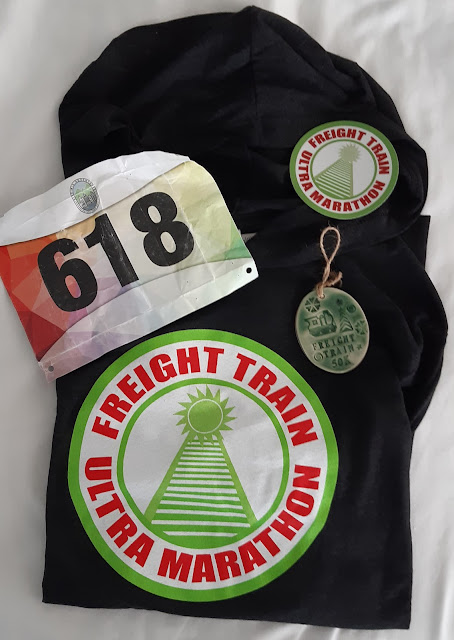
Swag: hooded shirt, ornament, sticker
and bib


Tuesday, December 7, 2021

Pass Mountain 50K - November 13, 2021

Nightmares

The night before the Pass Mountain 50K, I cannot sleep.  I'm worried about the weather for the race, specifically, the forecast for higher than normal temperatures.  I have a history of not coping well with hot conditions.  In June, I dropped out of Ran It with Janet 50K partly due to the 90 degree heat.  In February, 2020, I dropped from Elephant Mountain 50K, at least in part due to the heat. 

Cathy and Emaad choose another way at
Boyce Thompson Arboretum

Earlier on Friday Emaad and I meet our friend Cathy at the Boyce Thompson Arboretum in Superior. She is a member and an enthusiastic gardener, and she treats us to an hour long guided tour of the main trail at the arboretum. The shaded portions are pleasant, but I feel the heat when we are in unshaded parts of the walk. 

Even though I have a plan to deal with the heat, I spend a troubled night, never quite being able to sleep for any length of time.  No need for the alarm; I'm awake and up well before I have to be.

First Loop

The course consists of two loops around Pass Mountain.  From the race website, it looks relatively flat, with most of the 2500 feet of ascent in the two climbs from the second aid station (mile 6.8 of each loop) and the passage at Bulldog Saddle at the top of the trail.  And that climb is followed by a nice four mile descent back to the start finish area. Since we did over 3000 feet of climb at Boulder Field 50K, this doesn't sound at all bad.  And it is in the desert, so no roots to contend with or trip over. Maybe just a few rocks.

The race starts at 7 o'clock sharp. The 58 entrants in the 50K head out onto the smooth dirt of the trail.  Emaad and I are toward the rear and as usual we chat with the runners around us.  We don't push the pace, but don't go too slowly either, figuring that the more miles we can log while the sun is still low (sunrise was 6:56 a.m.) and the temperatures down, the better off we will be later in the day.

Emaad runs into the sun on the levee (mile 3)

The course rolls just a bit for the first couple of miles, then turns onto a levee built to protect a neighborhood on the edge of the park for flash floods. We get through the eponymously named Levee aid station (mile 3.8) in 44 minutes, get back on the levee and continue for a bit more before the trail leaves it for more generally flat track to the next aid station at mile 6.8.

From here it is 8.6 miles back to the start-finish.  I make sure that my hydration pack is filled to its 1.5 liter capacity. Fellow runner David, who is using trekking poles and has run the race previously, gives us a brief on what to expect ahead.

The course heads up gently, between the Cat Hills, then along a bit of gently rolling, but rocky, trail running to the east.  We chat with a couple of women runners about the difference of running in the East and the West.  A hiker wearing a sidearm passes us going the opposite direction. (Protection against snakes? Loaded with snake shot? Protection from other wildlife?) We are in a different culture here.

Looking toward Pass Mountain from the south (mile 4)

The trail turns northward and upward, but the rocks do not end.  The trail is rockier that I had anticipated and it makes running difficult. Up we go. Since this is the desert one can see the runners - actually mostly walkers - on the trial ahead and above.

Finally we come to a switchback that is just solid rock and steeply upward.  This is the point that David told us would mark the final ascent to Bulldog Saddle. Just before we reach the top we come upon a pair of mountain bikers preparing to descend that stretch.  It seems to be an ill-advised and particularly risky idea but we go on leaving them to their effort. We see them later in the day unscathed.

Cresting the saddle, we now have four miles and 700 feet of descent to the end of the first loop.  It should be a place to make up time.  Emaad takes off.  But I proceed slowly.  As I've gotten older, downhills have become troubling - I am becoming increasingly afraid of falling and am losing confidence in my ability to bound down them.  The trail is still rocky, and there is nothing be a steep slope on one side. A misstep, slip or stumble in the wrong direction and it will be a slide down a rocky, cactus slope for who knows how far. Adding to the concern, portions of the trail are eroded, further narrowing the path.

Headed toward Bulldog Saddle

I go on, unconfident of the trail, but confident that I'll make the four and a half hour cutoff at the end of the first loop.

Second Loop

Emaad is waiting for my at our drop bags.  The day is now hot, and the portapotty that I use is sweltering.  I change shirts, fill the hydration pack and grab my handheld water bottle.  My plan is to use the water in the hydration pack for drinking and the water in the handheld for cooling, pouring it on the cooling towel I have around my neck.

We cross the mat to start the second loop in 4:11.  This gives us officially 4:49 to run the second loop to finish under the official nine hour cutoff. But we not particularly concerned about that, knowing that the 50 milers on a somewhat differ course will still be out there later than us.

We have barely gone a few hundred yards than we come across a runner sitting by the side of the trail. He says he is OK but has decided to call it a day.  A bit further along we come across another runner walking back toward the start-finish.  He, too, tells us that he is calling it a day.

By now we are pretty much alone. I want to run, but Emaad urges that we go easy, as the time is approaching noon, the sun is high, there is no shade, the day has become hot and we still have a long way to go.  It's good advice.  We mostly walk, or walk and run.

We spy a runner ahead, mostly walking and talking on her phone.  When she is done with her call we fall in with her and the three of us proceed together sharing stories.  It turns out that she had run the 2019 DC North Face Endurance Challenge 50K, the same race at which Emaad and I had run a bit with ultralegend Dean Karnazes.

She is a recent graduate of George Washington University, and is interested in international humanitarian efforts.  I tell her that I know someone who works at the Agency for International Development and that if she wants I can put her in touch with him.  In an only-in-DC moment I tell her that I happen to have one of my business cards in the rear outside pocket of my hydration pack (how many other trail runners carry their business cards with them?) and that she is free to take a picture of it so that she can contact me later.  I had the business card with me because I had written the race emergency number on it in case I needed it on the trail. But still . . .  a business card?

She is talking about dropping at the Levee aid station, but we and the aid station workers talk her into going on. At one point Emaad and I get a bit ahead of her and exchange concern about her.  We wait and she catches up with us and assures us that she is fine, but is going to drop out at the Meridian aid station (mile 22.2). She has to get to CVS in time to get a COVID test as she is flying to Germany on Monday.

As we approach the aid station, a volunteer meets us.  He, too, tries to talk her out of dropping, but her mind is made up.  She calls one of her friends (one dropped, one finished) to come pick her up.  

Emaad has gone on ahead, and calls back to me to pick up his handheld, as he left it behind.  I do, and after a couple of hundred yards I curse myself, because in getting his I left my behind.  I turn back to get it. A volunteer sees me coming back and realizes what I had done, and brings it out to meet me, saving me precious steps.

Now we are alone and the day is hot.  We have been over this ground before, but somehow it seems longer, probably because we are going slower. (On the first loop we did the 6.8 mile distance from the start to the Meridian aid station in 1:27. It took 2:00 on the second loop.)

I'm keeping my cooling towel wet with water from the handheld. But the upward climb seems endless.  With no runners (or even hikers for that matter) on the trail ahead, it is hard to know where the saddle is.  All I see is mountainside, with no obvious way over.

But eventually we reach the "just rocks" part, and partially on all fours, I crest Bulldog Saddle.

Looking to the north from the Pass Mountain trail (mile 29)

As on the first loop, Emaad takes off downhill and I trudge downward. At least now this side of the mountain is partially in the shade. A good thing too, as I'm starting to ration both my drinking water in the hydration pack and the cooling water in the handheld.

About a mile down the trail I come upon Curtis, a runner who, it turns out, had been thru the Meridian aid station 18 minutes ahead of us.  He is not looking well.  I offer him a salt tablet, and I take my last one.  Then I go on, but keep looking back to see how he is doing.  He is moving forward, so I figure he will be OK. 

I've run out of water in my handheld, so I use water from my pack to wet my cooling cloth.  But than causes me to even further cut back on what I drink.  I try a trick from Emaad - take a sip and swish it in your mouth for awhile before swallowing.  Anything to make the water last.

With about a mile left, first one leg, and then the other starts to cramp. I use a nearby bench to press back and stretch.  Somewhat successfully, I resume moving.  But then I start to get lightheaded and stop on a rock to put my head down. The cramping resumes. I start to wonder if it is time to get out the business card to dial the emergency number.  But both the dizziness and cramping subside.  On I go. But I'm out of water.

I ask a runner headed in the opposite direction if he has a gel, forgetting the I have two on me.  He doesn't.  A bit later I cross paths with a mountain biker.  He asks if I'm OK, and when I hesitate, he asks if I want some water. He pours some, including some ice, from his hydration pack into my bottle. The cold water is refreshing, both inside and out.

Live Results Screenshot
And in a bit I pass the parking lot by the Wind Cave trailhead ("the false finish" as one runner described it on the first loop) and travel the half mile or so to the finish.  I cross the line and plunk down in a chair.  One of the finish line workers gives me my finisher's award and gets me something to drink and a snack.  Emaad, who finished 20 minutes ahead of me, comes over.  He tells me that he vomited after finishing, and one of the medical staff checked on him. 

Curtis comes in 20 minutes behind me.

Finisher or Not?

The live tracking shows that I finished in 9:29:47, 37th overall, and 24th male. I was the oldest finisher by five years.  Emaad finished in 9:09:33. Curtis was the only finisher behind me.

The temperature tops out at 88 degrees, ten degrees above the normal high for November 13 in Mesa. It takes a toll on the runners. Only 38 of the original 58 starters will be recorded as finishers, an attrition rate of 35 percent.  This is far above the attrition rate for the previous three Pass Mountain 50Ks, where the rates were 15, 13, and 14 percent, respectively.

When the results are posted to Ultrasignup, we three are all listed as DNFs. We went from finishers to non-finishers. 

At the Finish
Although we didn't make the announced nine hour cutoff, this DNF does not set will with me.  I email the race director, pointing out that at "the 2020 Elephant Mountain 50K [a race put on by the same company], 16 finishers who did not meet the 8-hour cutoff were recorded as finishers, including four who were over nine hours.  Just like Pass Mountain this year, that race had its inaugural 50 miler" so there were still runners out on the course when we finished. I ask that he include me, Emaad, Curtis and a fourth runner who was also over the nine hour cutoff.  Emaad also sends an email.

We get no response for eight days, so I write again. The race director responds to Emaad and I agreeing to do so, although not without a bit of a backhand:  "because you seem so passionate about receiving a finish for a race that you finished over the official cutoff, we will allow your result to be posted."  But he doesn't do so for Curtis who remains a DNF. On the other hand, while not telling us, he moves a 50-mile finisher from a reported "did not finish under the cutoff" to an official finisher.  

We didn't make the cutoff. If, at finish I was told that I was a DNF I would have accepted that. But the company ignored the cutoff for another one of its races, so consistency is expected. Once you tell me I'm a finisher and give me a finisher's medal, you do not get to unfinish me. (And at my age, I need all the finishes I can get.)

Swag: Shirt, Bib and
FINISHER'S MEDAL